London's Mobile Connectivity
Explore measures of mobile network performance across London
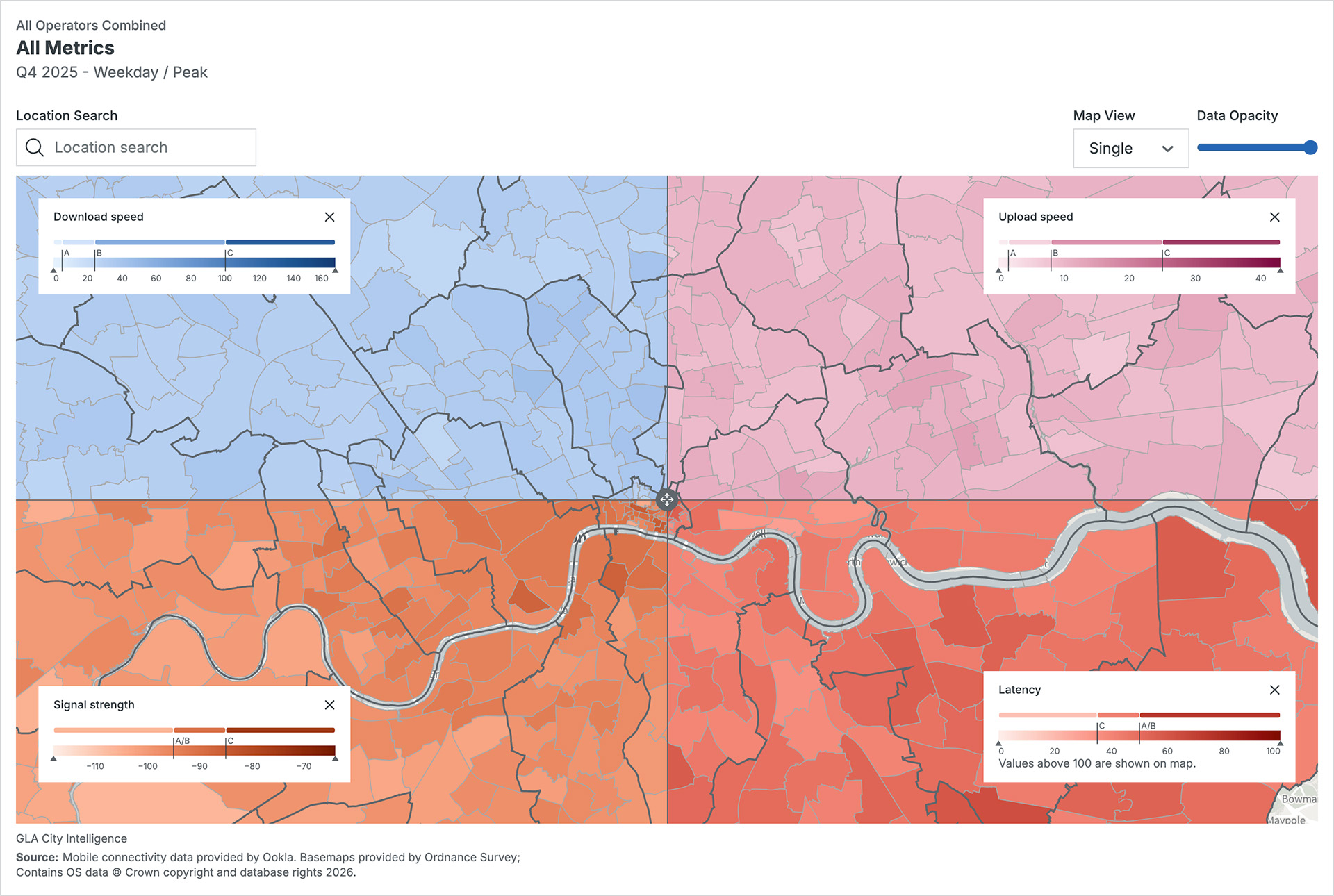
Using real-world data, explore how performance varies between locations, compare networks, and see how mobile connectivity changes between different times of the day and weekdays and weekends.
Gain insight into mobile connectivity performance:
Download and upload speed
Download speed (Mbps) measures how quickly data can be received, such as when streaming or downloading content. Upload speed (Mbps) measures how quickly data can be sent, such as when uploading photos or video.
Signal strength and latency
Signal strength (dBm) indicates the strength of the mobile signal being received. Latency (ms) measures the time it takes for data to travel between a device and the network, which can affect responsiveness in activities such as video calls and online gaming.
Multiple network operators
Download speed, upload speed, signal strength and latency across London are shown as an average (and individual) measure of for four individual network operators.
Why did we create it?
Traditional mobile coverage maps can tell us where a signal is expected to be available, but they do not always reflect people’s real-world experience. As mobile connectivity becomes increasingly important to London’s economy, public services and daily life, there is a growing need for better evidence on how networks are actually performing.
The map was developed to provide a more detailed picture of mobile performance across London, helping to identify areas where coverage, capacity or user experience might be falling short.
The map forms part of the Mayor's wider work to improve digital connectivity across London and was developed alongside the London Mobile Connectivity Framework to help build a more detailed understanding of mobile connectivity challenges across the capital.
How can it be used?
The map is intended to help people better understand mobile connectivity challenges in their area and support decisions that improve coverage and capacity across London
It can be used to identify locations where mobile performance is weaker than expected, where networks may be under pressure from growing demand, or where new homes, workplaces or major developments may require additional mobile infrastructure in the future.
Alongside the London Mobile Connectivity Framework, the map provides evidence that can help identify where mobile networks may be under pressure, understand the likely causes of poor performance, and inform decisions about how connectivity can be improved.
Start exploring
mobile performance data across London to understand where connectivity challenges exist and how they vary between locations, networks and times of day.
- Upload and download speed (Mbps)
- Signal strength (dBm) and Latency (ms)
- Four network operators
- Weekdays vs Weekends
- Peak vs off-peak